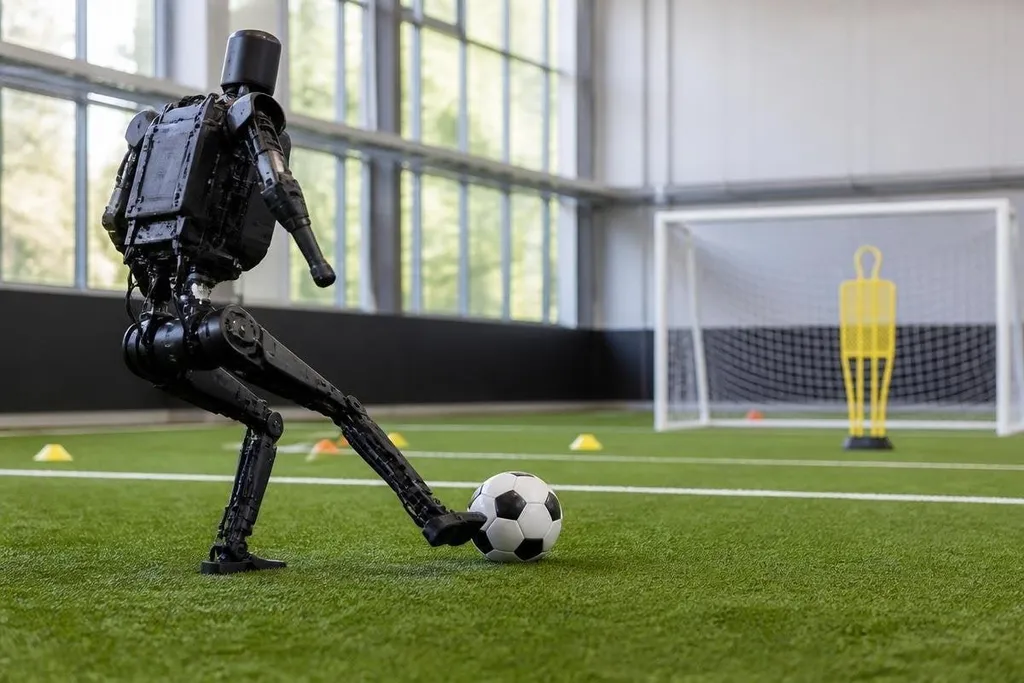
A robot that kicks a ball for a video is easy to notice. One that repeats the same drill for two hours, records each mistake, and keeps people safe would matter far more to a sports team.
Quick read
- Training robots need repeatable motion, clear safety limits, and useful records.
- Robot competitions will test control under pressure, not only speed or strength.
- The first buyers are more likely to be clubs, labs, and venues than fans.
Where sports robots can help
Sports place strict demands on movement. An athlete changes speed, reacts to contact, tracks an object, and makes a decision with incomplete information. A robot that works in this setting needs more than motors and a camera.
Training is the clearest starting point. A robot could serve the same ball, hold a fixed defensive position, or repeat a footwork drill at a chosen speed. The value comes from repeatable practice: the coach can change one setting and compare the next attempt with the last one.
That record matters. A useful training robot would log reaction time, joint position, contact force, or missed targets in a form a coach can read. A pile of sensor data is not useful until it changes the next drill.
Sports robots could also help with access. A powered exoskeleton may support a person’s legs or arms during a session, but its use would depend on fit, control, medical advice, and the sport’s rules. Those limits need to be set before a team buys the hardware.
Competition will expose the hard parts
In a clean test area, the robot can repeat a planned move. A match adds blocked sensors, changing light, uneven ground, sudden contact, and other moving bodies. Each fault changes the task because the robot must sense the new state before it acts.
That makes recovery more useful than speed alone. A running robot that falls may lose the event, damage its frame, or enter the path of a person. A slower robot that detects a fall, stops its motors, and waits for help may be safer for a training hall.
Robot football makes this plain. The robot must locate the ball, estimate its own position, choose a path, and control its legs at the same time.
Small errors can compound: a missed image shifts the path, the wrong path changes the kick, and the failed kick changes the next decision.
The test record needs more than the final score. Robot24.com can tie a sports robot’s task, control method, test setting, and result to the claim being made about competition. Those details lead to the harder question: who pays for the machine when the match ends?
The business case starts off the field
Fans may pay to watch robot competitions, but that income is hard to predict before a league has regular teams and clear rules. Sports venues have more practical reasons to test robots, such as field inspection, camera movement, equipment delivery, and surface checks.
Those jobs still need proof. A venue manager should ask how the robot behaves near athletes, how staff stop it, and how often it needs charging or repair. A machine that saves one worker a short walk may not cover its purchase, service, and training costs.
Training data could make the better case. A club already pays coaches to assess movement, but a robot record must add useful detail without taking attention away from practice. If staff spend more time cleaning data than coaching, the system has missed its job.
The open issue is trust. Coaches need to know when a sensor failed, when a model made a guess, and when a human must take control. Clear logs and a physical stop button matter more than a polished demo.
A buying and testing checklist
Before a club, venue, or lab funds a sports robot, check these points:
- Name the drill: write down the exact task, surface, speed range, and success measure.
- Set the safe zone: mark where the robot may move and how a person can stop it.
- Check the record: confirm which data it stores, who can read it, and how long the files remain available.
- Test failure: remove a target, block a sensor, or stop the robot during a controlled session.
- Count the labor: include charging, setup, repairs, software checks, and staff training.
- Set a review date: pause the trial if the robot cannot meet its written measure after the agreed test period.
Sports robots will grow through narrow jobs with clear results. The next useful proof may be a training log, a safe recovery, or a full season without constant staff intervention. I’d judge every sports robot by that record before its fastest move.